|
Meeting Expectations
Enterprise systems are commonplace in today's business, and typified by Enterprise Resource Planning (ERP) applications so widely used by manufacturing, distribution and other industries. Over the past two decades, such applications have become the de facto standard as business management tools, an accomplishment recognized by all except the most cynical of commentators. In addition to e-commerce, additional applications areas have extended the functional scope of ERP. Examples are Cooperative Planning, Forecasting and Replenishment (CPFR), Customer Relationship Management (CRM), Business Intelligence, Advanced Planning Systems (APS) and Supply Chain Planning (SCP), Product Data and Lifecycle Management (PDM, PLM).
For many companies, these applications have proven their worth, but it is still accurate to state that relatively few have matched the initial expectations. There is another way of looking this commonplace state of affairs: Even fewer companies are achieving the full extent of potential benefits and return from their investments in ERP.
Various reasons have been put forward that are accepted for this performance but are still disappointing. Remedial actions often result in higher investments in implementation and extraordinary levels of consulting assistance. Others have agreed with the proposals of software vendors and put more money into additional applications. The true cause is that in common with nearly every commercial computer application of any type, ERP has one specific inadequacy. This shortfall is nothing short of a black hole, because it has taken us years to recognize that it is there, and how it inhibits effective and more successful use. The problem is an inherent flaw in the fundamental design of the applications, a disproportionate focus on the functions for an individual departmental user.
The Fundamental Weakness
With ERP, if the expected plan comes to pass and is executed without exceptions, then there is relatively little that needs to be done. This is the case for most other enterprise business systems, from distribution and banking to insurance and healthcare. Much of the promise and sales emphasis of software vendors is exception management, or the use of applications to solve problems. Unfortunately this focus ignores the fact that there are two levels of problem solving activity, so neither have been considered by the software developers.
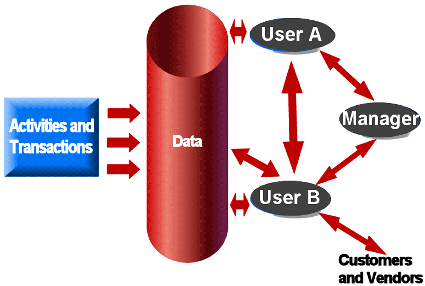
A typical applications system is illustrated in Figure 1,
with transactions updating the application files. Two users, A and B, are both individuals within a departmentally organized function. They may deal with customers or vendors, or have internal responsibilities only.
These users could be order entry clerks, financial analysts, materials planners, buyers, accounting personnel, design engineers, sales people, forecast supervisor, and so on, in many environments and different industries. They could work in the same department, possibly in close proximity, or they could be in remote locations.
Consider what happens in your business when the following situations
arise:
 User A needs to consult with user B? User A needs to consult with user B?
User B needs user A to take some action?
A manager needs to communicate with A and/or B.
Both A and B have to agree and/or approve an action?
|
|
Problem Solving
Approaches
In such circumstances and to resolve similar or associated problems,
we often start with a phone call, and then have to leave a message and
call back. Notes may be written and passed, or used as reminders for
future action. Readers will be only too familiar with the various techniques,
from pink phone message slips to post-it notes, pocket note pads and
spiral notebooks. Even personal organizers and Personal Digital Assistants
(PDA's) are just technological advances of the same approach, and suffer
from the same limitations. These communications activities are level
1 of problem solving activity.
When these measures do not get the job done, we resort to a meeting,
bringing the involved parties together to sort things out. In fact,
because we know that the level 1 techniques cannot cope, we even schedule
regular meetings, and there is never a lack of agenda items. This is
the second level of problem solving activity. John Cleese of Monty Python
fame is also the founder of a company that makes industrial training
films. His "Meetings, Bloody Meetings" is a classic even though it was
made nearly thirty years ago. This is a key point. Despite all the technology,
the approaches in both level 1 and level 2 are little different from
the way we did things in the 1930's!
None of these techniques are integrated with the enterprise information
systems on our desks. Users have to access these tools as an additional,
separate, later and often cumbersome step. There are no connections
from the communications to the relevant data within the enterprise applications.
Further, there is no capability for archiving, analysis or audit trails
of the actions and communications. Consider two aspects of your own
job situation. What do you have to do before responding to an incoming
email? How do you access the data and communications that were relevant
to a decision taken yesterday?
The Black Hole
There are countless examples of such intra-user and cross-department
communications and meetings that are external to the applications. These
are commonplace activities, especially for administrative and supervisory
personnel, and include such as the following.
Order entry needs to consult with sales representative on pricing or
terms?
Assembly foreman needs the buyer to take action on a component shortage?
Master scheduler and production control need to agree on schedule?
Forecasting coordinator needs to
talk to the large account sales rep.
Credit control and sales are at cross-purposes over a customer.
Implementation of an engineering
change has to be coordinated with production.
Service desk should be informing others of customer quality or technical
issues.
Schedule changes need to be discussed and agreed with a vendor.
|
|
|
|
| Figure 1: Typical system
and user relationships |
|
|
It is a fact that with nearly every
business system, users are forced into a restricted and unproductive
mode of operation, especially when they have to work with others (which
is most of the time for many of us). This weakness is the Black Hole
of ERP and other enterprise applications. There is a chronic and critical
need for a communications and activity management approach that is integrated
into the day-to-day applications, customizable to fit with business
processes, and communications data for recall and analysis. The potential
pay back of such a tool is substantial, from the daily productivity
improvements to enhanced customer service and improved asset utilization.
The New Solution
It took centuries for the Black Holes of space to be identified and the impacts recognized. Fortunately for users of enterprise or ERP suites like
PRMS, BPCS and MAPICS, the solution to the Black Hole of ERP is available today from Systems Conversion Ltd. Final Link( is a unique communications tool, integrated with the information in enterprise systems with a central repository for priority management, progress monitoring, and archiving.
Final Link is designed with one objective: personal employee productivity that will enhance corporate business performance. From product data management (PDM), customer relationship management (CRM), vendor relationship management (VRM), or from salespeople on the road to the plant floor, there is significant potential for improvement in exception handling and communications.
 Benefits Benefits
With Final Link you will have the solutions to the dysfunctional communications approaches. Your company's bottom-line will reflect the results of using Final Link, so it is appropriate to assess the beneficial impact on your business when:
Customers get faster response to their questions or changes, and know that your sales people have effective communications with other departments.
Suppliers know they will get early warnings of changes in specifications and schedules, because you are well in control.
Engineering change request and quality problems are resolved quickly and effectively.
Price quotes and schedules are quickly and fully coordinated between sales, production and finance.
Proactive notification of potential materials and production problems or situations are easily communicated and updated.
The several departments that need to be involved swiftly deal with credit exposures.
Return to Final Link
Main Page CLICK>>
|